Advanced paper #2: Stirling engines
This was on BoingBoing August 10th, but it’s too good to pass up so what the hell. Better late than never. Here’s a graphic example of how far away we are from tapping the energy that is all around us, while we stare ourselves cross-eyed on oil.
It’s a Stirling engine, made from paper no less, chugging away on the heat from a coffee cup.
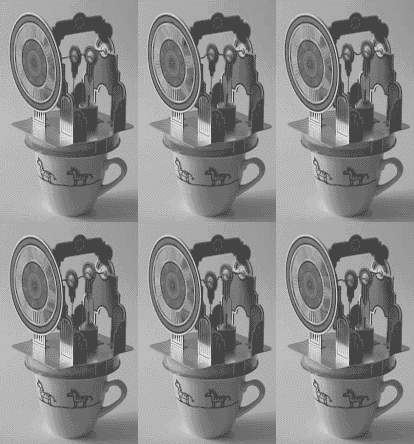
Stirling engines, to define terms, work by using temperature differences as their source of power. Any difference will tend to equalize, like water flowing down hill, and that flow can be tapped. There are temperature differences all over the place: between you and the ambient air (could be used to power wearable gadgets or medical devices), between the roof of a house and the basement (a/c, refrigerators, lightbulbs), between the surface of the ocean and a few meters down (power generation, desalination in cold climates), and so on. Stirling engines aren’t just a parlor trick. They’ve already been used to run cars and refrigerators.
One of the main problems with them has been that the critical parts have to be very precisely shaped, but are usually subject to high temperatures (eg in cars) and will therefore deform unless made out of expensive materials. Modern manufacturing methods and materials science have largely solved that problem, but there’s no big push to mass produce Stirling engines because it’s more trouble to change manufacturing processes — initially — than to just continue with internal combustion machines.
The English-language web site has more information, complete with Google’s hilarious automatic translation. A good example of why translators won’t be out of jobs any time soon. (Link to the German site where you can also order your very own die-cut paper, coffee cup machine. Precision German engineering!)